The Art and Utility of Colorful Flower Design Seamless Patterns in Modern Visual Culture
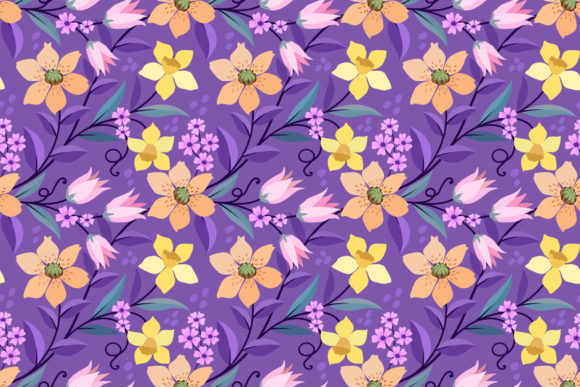
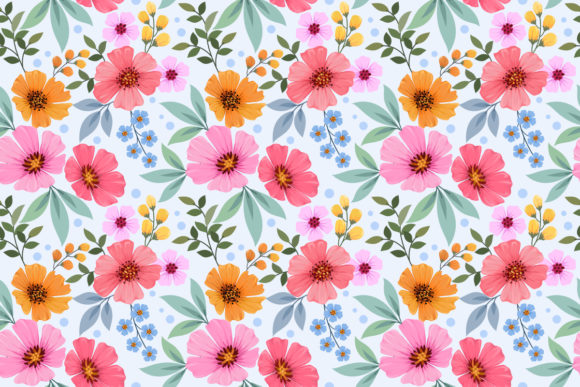
The visual language of floral motifs has accompanied human creativity for millennia, yet the Colorful Flower Design Seamless Pattern represents a distinctly contemporary fusion of botanical beauty and digital precision. Unlike a single illustration or a static painting, a seamless pattern tiles infinitely without visible edges, creating a continuous, unbroken field of blossoms, leaves, and stems. This characteristic makes it indispensable across design disciplines, from textile manufacturing to user interface backgrounds. The “colorful” dimension elevates the concept further—these are not subdued, monochromatic arrangements but vibrant, energetic compositions that command attention and evoke specific emotional responses.
Understanding the mechanics behind a Colorful Flower Design Seamless Pattern begins with the notion of repeatability. Every element within the design boundary is carefully positioned so that when the pattern unit is duplicated horizontally, vertically, or both, the transitions disappear. A flower petal cut off at the left edge reappears identically on the right, continuing its natural curve. This technical requirement does not constrain creativity; rather, it imposes a fascinating discipline on the designer, who must think in modular terms while preserving organic, flowing forms. The result feels effortless to the viewer—a garden without fences, stretching limitlessly in every direction.
Core Visual Characteristics That Define Impact
The best examples of a Colorful Flower Design Seamless Pattern share several recognizable traits. First, color harmony is paramount. Even with a wide palette—crimson roses, sunflower yellows, lavender purples, and fresh greens—the colors must coexist without clashing. Designers often anchor the composition with a unifying background tone or use analogous and complementary color schemes deliberately. Second, scale and density matter enormously. A pattern intended for a phone case requires a different rhythm than one destined for wallpaper. Dense, small-scale repeats create texture, while larger, more widely spaced motifs read as bold statements.
Stylization also plays a crucial role. Some patterns lean into hyper-realism, with photorealistic petals and dewdrops, while others embrace flat vector aesthetics, watercolor washes, or even geometric abstraction. The choice of style determines the pattern’s cultural resonance. A delicate, impressionistic floral pattern might suit luxury stationery, whereas a bold, pop-art-inspired arrangement could become the signature print for a streetwear brand. The seamless nature of the design ensures that regardless of the application surface area, the visual language remains consistent and immersive.
Material Applications Across Industries
Perhaps the most immediate and traditional use of a Colorful Flower Design Seamless Pattern lies in fabric and fashion. The textile industry relies heavily on seamless repeats for screen printing, digital fabric printing, and weaving. A dress constructed from fabric bearing a lush floral pattern depends entirely on the seamlessness for its professional finish. If the pattern misaligned at the seams, the garment would look fragmented and cheap. For swimwear, scarves, and activewear, colorful florals inject personality and seasonal relevance. Manufacturers can license a single pattern and apply it to entire collections, ensuring visual consistency across products.
Beyond apparel, home décor represents an enormous domain. Wallpaper has experienced a renaissance, and contemporary designs frequently feature oversized, painterly floral repeats that transform rooms into immersive botanical environments. Cushion covers, duvet sets, curtains, and table linens all serve as canvases. A restaurant owner might choose a cheerful, eclectic floral tablecloth pattern to cultivate a welcoming, rustic-chic atmosphere, while a hotel chain could commission a subtle, elegant motif for lobby upholstery. In each case, the seamless repeat guarantees that the material can be cut, sewn, and assembled without disrupting the visual flow.
Digital Environments and Interactive Media
The digital realm has embraced the Colorful Flower Design Seamless Pattern with equal enthusiasm. Website backgrounds, particularly for brands in beauty, wellness, lifestyle, and gifting, utilize subtle floral patterns to soften the interface and add warmth without overwhelming the content. A blog dedicated to gardening might feature a delicate wildflower repeat behind its header, reinforcing the topic without screaming for attention. Mobile app splash screens, social media story backgrounds, and digital scrapbooking kits all benefit from the optimistic energy that colorful florals provide.
Game design and virtual environments also rely on seamless textures. In a simulation game or a metaverse space, the ground might be carpeted with a stylized field of flowers that repeats endlessly, reducing the computational load while maintaining aesthetic appeal. Character customization options—dresses, shirt overlays, furniture skins—all draw from the same principle. The ability to map a 2D pattern onto 3D surfaces without visible seams is purely dependent on the pattern's design integrity, making the creator’s technical skill as vital as their artistic vision.
Benefits That Extend Beyond Aesthetics
While beauty is the obvious draw, functional advantages make the Colorful Flower Design Seamless Pattern a strategic asset. Scalability tops the list. A single well-crafted pattern file can adapt to a business card, a billboard, or a king-size bedsheet without losing fidelity or requiring redesign. This flexibility translates directly into cost savings and brand consistency. A small business owner can commission one floral pattern and use it across packaging, website, social posts, and product tags, creating a cohesive visual identity rapidly.
Emotional and psychological impact is another significant benefit. Colors and flowers carry deep symbolic weight. A pattern combining sunflowers, daisies, and bright orange accents radiates optimism and energy, while one with peonies, roses, and soft blush tones communicates romance and tenderness. Designers and marketers can harness these associations deliberately. A wellness brand might use calming blue delphiniums and lavender sprigs to suggest tranquility, whereas a children’s toy company could deploy playful, exaggerated cartoon blooms in primary colors. The seamless repeat turns these emotional cues into an ambient, all-encompassing experience rather than a single focal image.
Additionally, there is a powerful versatility in combination. A Colorful Flower Design Seamless Pattern can serve as a primary design element or as a supporting backdrop. It pairs beautifully with solid blocks of color, typographic treatments, and even photographic overlays. Greeting card designers frequently layer text and gold foil stamping over a softly patterned floral background. Stationery suites for weddings often combine floral envelope liners, belly bands, and invitation borders, all using different scales or recolored versions of the same core repeat.
Creation Processes and Tools
The journey from concept to a polished Colorful Flower Design Seamless Pattern involves both artistic vision and technical execution. Many designers begin with hand-drawn sketches or watercolor paintings, which they then digitize, clean up, and arrange in software such as Adobe Illustrator or Procreate. The manual approach preserves an organic, imperfect quality that digital-only vectors can sometimes lack. Alternatively, some artists work entirely digitally from inception, using vector brushes to construct individual flowers and leaves as reusable assets, then assembling them into a repeat block.
The technical heart of the process involves converting the assembled artwork into a seamless tile. Traditional methods include the offset filter technique, where the canvas is split into quadrants and the center cross is repaired to create seamless blending. Specialized pattern-making tools and plugins have streamlined this, but the designer’s eye remains irreplaceable. Detecting awkward gaps, unintentional lines of repetition, or strange rhythmic clustering requires judgment. Testing the pattern at various scales and on mockups—pillows, tote bags, smartphone screens—is standard practice to ensure the repeat behaves correctly in intended contexts.
Observing trends, the current landscape shows an appetite for maximalism and nostalgic revival. Vintage-inspired florals reminiscent of 1970s wallpapers, chintz fabrics, and Liberty prints have surged back, often updated with neon accents or metallic effects. Meanwhile, minimalist line-art florals with selective pops of color cater to modern Scandinavian-influenced aesthetics. The common thread remains the demand for color and the comfort of nature-derived imagery. As consumers spend more time in digital spaces, the craving for organic, living motifs intensifies, keeping the colorful floral pattern both relevant and evolving.
Strategic Considerations for Different User Groups
For small business owners and entrepreneurs, investing in or creating a bespoke floral pattern can differentiate a brand in saturated markets. Rather than relying on generic stock patterns that competitors might also use, a custom design builds a unique visual asset. Licensing a pattern from an independent artist supports the creative economy while giving the business exclusive or semi-exclusive usage rights. The key is selecting a style that aligns precisely with brand values—whimsical, elegant, edgy, or understated—and then applying it consistently across all customer touchpoints.
Educators and researchers studying visual communication or textile history find rich material in the evolution of floral pattern design. The seamless repeat itself, as a concept, connects to mathematical tessellation and symmetry groups. Exploring how different cultures interpret floral motifs—from intricate Indian block prints to bold Mexican embroideries adapted into digital repeats—reveals stories of trade, colonization, and aesthetic exchange. A study unit on pattern design can bridge art, geometry, cultural studies, and technology, showing students how a seemingly simple decorative art form encapsulates complex ideas.
Hobbyists and DIY enthusiasts engage with Colorful Flower Design Seamless Pattern resources through platforms like Spoonflower, Creative Fabrica, or Etsy, where they can download or purchase patterns for personal projects. Scrapbooking, custom gift wrap, doll clothing, and upcycled furniture all become richer with the addition of thoughtfully chosen floral prints. Learning to recolor or slightly modify existing patterns introduces novices to the basics of digital design in an approachable, rewarding way. The community around pattern design is notably collaborative, with forums and social groups sharing tips on color palettes and repeat techniques.
Manufacturers and production managers need to evaluate technical specifications carefully. The resolution of the pattern file must match the printing method. Screen printing requires separated color layers, while direct-to-garment digital printing can handle full-color continuous tone art. Seamless does not automatically mean print-ready; the repeat dimensions must align with the fabric width or panel size to avoid awkward cut-offs. Communication between the pattern designer and the production team ensures that the vibrant screen vision translates faithfully into the physical product without surprises.
Sustainability and Ethical Dimensions
An often-overlooked conversation centers on sustainability. The fashion and textile industries face growing pressure to reduce waste. A well-designed Colorful Flower Design Seamless Pattern can contribute positively by minimizing fabric waste during cutting if the repeat is engineered sympathetically. Additionally, digital sampling—using the pattern file to generate realistic product mockups—reduces the need for physical prototypes, cutting down on material and shipping waste. Consumers drawn to floral patterns may also associate them with nature, making them receptive to brands that pair botanical aesthetics with genuine environmental commitments, such as using organic fabrics or eco-friendly dyes.
Ethical usage also extends to cultural sensitivity. Floral patterns can reference traditional artwork from specific regions, such as Japanese chintz or Ukrainian petrykivka. Designers and businesses should approach such inspirations with respect, acknowledging sources and, where appropriate, collaborating with artists from those cultural backgrounds rather than extracting motifs superficially. Acknowledgment transforms a simple pattern into a bridge of appreciation rather than an act of appropriation.
Long-Term Value and Future Outlook
The Colorful Flower Design Seamless Pattern occupies a permanent place in the visual toolkit because it satisfies a fundamental human attraction to color, life, and organized beauty. As augmented reality and virtual try-on technologies advance, the ability to visualize a floral pattern on a sofa or a dress before purchase will become standard, making high-quality pattern files even more commercially valuable. Generative AI tools have begun assisting with rapid pattern prototyping, but curatorial judgment remains essential. The most memorable patterns still spring from a human sense of rhythm, surprise, and emotional nuance that algorithms only approximate.
Ultimately, investing attention in colorful floral seamless patterns—whether as a creator, user, or observer—means participating in a design tradition that spans hand-blocked chintz, Victorian wallpapers, mid-century barkcloth, and tomorrow’s interactive smart fabrics. The tile may be small, but the field it creates is boundless, and within that field, flowers bloom forever.