SPA Floral Clipart and Patterns: A Practical Guide for Designers and Creators
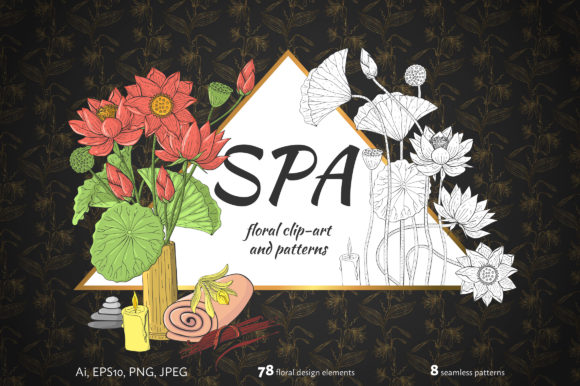
SPA Floral Clipart and Patterns refers to a curated collection of botanical-inspired digital assets—primarily vector-based illustrations and seamless repeating patterns—that emphasize tranquility, balance, and natural elegance. Unlike generic floral graphics, these assets are intentionally designed with spa, wellness, and holistic branding in mind: soft palettes, flowing lines, minimal detail, and harmonious compositions. They’re commonly used in wellness studio branding, meditation app interfaces, printable self-care journals, aromatherapy packaging, and yoga studio marketing materials.
What Sets SPA Floral Clipart and Patterns Apart
The distinction lies not just in subject matter but in design intent and functional application. While many floral clipart libraries prioritize realism, maximalism, or seasonal variety, SPA Floral Clipart and Patterns focuses on restraint and resonance. Petals are often simplified into gentle curves; leaves taper without sharp edges; stems follow organic, unhurried rhythms. This isn’t accidental—it’s calibrated for legibility at small sizes (e.g., app icons), scalability across print formats (from business cards to wall banners), and visual compatibility with muted, earthy, or pastel color schemes common in wellness contexts.
Most collections include both standalone clipart elements—individual blossoms, sprigs, or botanical silhouettes—and repeatable pattern files (often in .PNG with transparent backgrounds and .SVG or .EPS for vector editing). Some also provide layered PSD files for custom color adjustments, making them adaptable for brand consistency without requiring advanced illustration skills.
How It Compares to Broader Floral Design Resources
When evaluating options, it helps to distinguish between three overlapping categories: general floral clipart, botanical illustration libraries, and wellness-specific graphic sets.
- General floral clipart tends to be broader in scope—covering roses, sunflowers, tropical blooms, and holiday arrangements—but often lacks cohesive stylistic continuity. It may include photorealistic elements or cartoonish interpretations that clash with serene, minimalist wellness aesthetics.
- Botanical illustration libraries (especially those sourced from historical archives or scientific references) offer high fidelity and taxonomic accuracy—but their formal, detailed rendering can feel clinical or overly academic in a calming context. Scaling them down for web use may obscure fine linework, and recoloring complex layers can be time-consuming.
- SPA Floral Clipart and Patterns sits between the two: stylized enough for emotional resonance, structured enough for practical reuse, and consistent enough to support unified visual systems across multiple touchpoints.
This doesn’t mean it’s universally superior—just differently optimized. For example, a boutique tea brand launching a vibrant, summery line might find its palette too subdued; a medical clinic seeking authoritative imagery may prefer more precise anatomical accuracy. Context determines fit.
Strengths and Real-World Fit
Its primary strengths are coherence, adaptability, and mood alignment. Because assets share a unified line weight, spacing rhythm, and tonal range, combining a clipart element with a pattern background rarely results in visual dissonance—a common pain point when mixing resources from disparate sources.
Practically, this translates to efficiency. A yoga instructor designing a workshop handout can drop a single lavender sprig into a header, then tile a matching eucalyptus pattern behind text—both assets scaling cleanly, aligning intuitively, and reinforcing the same calm aesthetic. Similarly, a wellness app developer integrating SVG icons can maintain consistent stroke thickness and negative space across navigation elements without manual redrawing.
Another advantage is licensing clarity. Most reputable SPA Floral Clipart and Patterns collections are offered under straightforward commercial licenses—no ambiguity about social media use, client deliverables, or limited-run merchandise. That predictability matters when managing freelance projects or internal brand guidelines.
Tradeoffs and Limitations to Consider
Like any specialized resource, it comes with inherent tradeoffs. The emphasis on serenity means less visual energy or contrast—making it less suitable for bold, youthful, or high-energy brands. You won’t find fiery peonies or dramatic black-and-white contrasts here; subtlety is built into the foundation.
Also, while many sets include variations in bloom type (chamomile, jasmine, lotus), the botanical range is intentionally narrow. It prioritizes symbolic resonance—lotus for renewal, lavender for calm, ferns for growth—over taxonomic diversity. If your project requires accurate depictions of regional flora or seasonal specificity (e.g., cherry blossoms for spring festivals), you may need supplemental reference material or custom illustration.
File format support varies by provider. Some collections lean heavily on raster formats (.PNG), which work well for web but limit resizing for large-format print without quality loss. Others supply full vector suites—but may omit editable layers or color variants, requiring manual adjustments in Illustrator or Affinity Designer.
When It’s the Right Choice—and When It’s Not
SPA Floral Clipart and Patterns is especially well-suited when:
- You’re building or refreshing a wellness, mindfulness, or holistic health brand identity and need visual cohesion across digital and print assets;
- Your team has intermediate design skills—not professional illustrators, but comfortable using vector tools or layout software;
- You value time efficiency over exhaustive customization and want reliable, mood-appropriate starting points;
- Your audience responds to quiet sophistication rather than visual intensity or novelty.
It’s less ideal when:
- Your project demands strong cultural specificity (e.g., traditional Japanese ikebana motifs or South American medicinal plant iconography) that falls outside the collection’s intentional scope;
- You require animation-ready assets (e.g., layered, frame-optimized files for Lottie or After Effects); most SPA Floral Clipart and Patterns sets are static by design;
- You’re working under tight budget constraints and need completely free resources—while some providers offer limited free samples, full access typically requires a one-time or subscription fee, unlike certain open-source botanical SVG repositories.
Making an Informed Decision
Before selecting SPA Floral Clipart and Patterns—or any specialized graphic resource—consider your workflow, output requirements, and long-term usage. Ask yourself:
- Do the included color palettes align with your existing brand palette, or will significant recoloring be needed?
- Are file formats compatible with your primary tools (e.g., Figma, Canva, Adobe Creative Cloud)?
- Does the license cover your intended use cases—including client work, resale items like planners, or SaaS platform integration?
- Is there sufficient variation in scale and composition to avoid repetition across touchpoints (e.g., a large banner versus a tiny favicon)?
Many creators find value in pairing SPA Floral Clipart and Patterns with complementary assets—such as neutral texture overlays, minimalist line icons, or custom typography—to add depth without disrupting harmony. That kind of thoughtful layering often yields stronger results than relying on a single resource alone.
Ultimately, SPA Floral Clipart and Patterns isn’t about finding “the best” floral graphics—it’s about choosing the right tool for a specific expressive goal. Its strength lies in intentionality: every curve, hue, and spacing decision supports a singular aim—evoking calm through visual language. When that aim matches your project’s purpose, it becomes more than decoration. It becomes part of the experience.