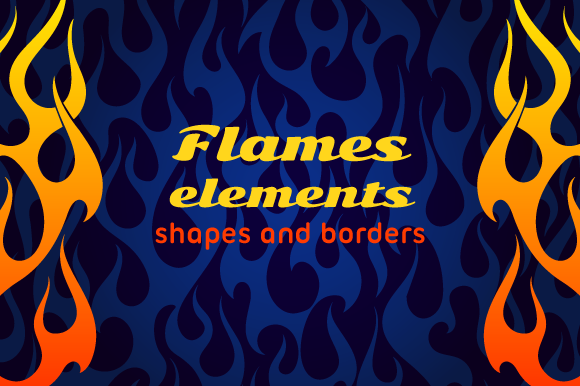
Old School Hot Rod Flame Elements Set
The Old School Hot Rod Flame Elements Set is a curated collection of vector-based flame graphics rooted in mid-century American automotive customizing culture—think ’40s–’60s kustom kars, chopped tops, and hand-painted pinstriping. Unlike generic flame brushes or raster overlays, this set delivers scalable, editable, high-fidelity flame motifs designed for precision placement, color adaptation, and stylistic consistency. It’s not just decoration; it’s a visual language asset—one that communicates attitude, heritage, and craftsmanship at a glance.
Where It Fits in the Creative Workflow
This set doesn’t sit in isolation. It integrates into stages where visual tone, brand voice, or thematic cohesion matters: concept development, mockup refinement, asset production, and final delivery. Designers use it early to establish mood boards for retro-adjacent branding projects—say, a craft brewery launching a “Garage Brew” line or a boutique apparel label building a vintage motorsport identity. Marketers layer elements into social ads or email headers to signal authenticity without relying on clichéd stock imagery. Educators embed them into presentation slides when teaching design history or material culture. Even hobbyists apply them to laser-cut signage, vinyl decals, or CNC-routed dash panels—bridging digital intent with physical output.
Before the Project: Preparation and Intentionality
Using the Old School Hot Rod Flame Elements Set begins before opening your design app. Ask: What narrative am I reinforcing? Is this about nostalgia, rebellion, craftsmanship, or regional identity? Flame placement isn’t arbitrary—it follows real-world logic. On a car fender, flames flow front-to-back and taper toward edges. On a t-shirt, they anchor to seams or pockets. Reviewing reference photos of authentic 1950s flame jobs helps avoid visual dissonance (e.g., symmetrical flames on asymmetrical surfaces). Organize the set by scale (small accent flames vs. full-side sweeps), orientation (left/right-facing), and complexity (single-layer vs. multi-hue gradients) before starting. This saves time during layout and ensures consistency across deliverables.
Compatibility and Platform Readiness
The set typically ships as AI, EPS, and SVG files—formats that preserve vector integrity across Adobe Creative Cloud, Affinity Designer, Figma (via SVG import), and even web-based tools like Canva (with minor rasterization trade-offs). No plugins or proprietary software are required. If you’re collaborating across teams, confirm file-handling protocols: designers may edit AI layers directly, while developers extract SVG paths for responsive web use. For print, verify CMYK support and spot-color readiness—some versions include PMS swatches for screen printing accuracy. Always test export settings: a 300 DPI PDF for offset printing behaves differently than an SVG optimized for CSS animation.
During Execution: Precision Over Decoration
Flames gain impact through restraint—not coverage. One well-placed flame along a product silhouette often reads stronger than three scattered across a background. Use alignment guides and smart objects to lock proportions when scaling. Adjust stroke weight and edge softness to match your medium: sharp, crisp outlines suit vinyl decals; slightly feathered edges work better for digital banners viewed on mobile. When recoloring, respect period-appropriate palettes—candy apple red over black base, turquoise over cream, or gold leaf over charcoal—but don’t treat those as rules. The set’s layered structure allows swapping base colors independently from highlights or shadows, enabling modern reinterpretations without losing structural authenticity.
Workflow Integration Examples
- Brand Identity Refresh: A small auto shop rebranding its website uses a single flame motif as a dynamic logo lockup—rotating subtly on hover, synced to scroll position via lightweight JavaScript. The same vector serves as a favicon, social avatar, and invoice watermark.
- Educational Resource Development: An art history instructor imports flame vectors into Illustrator, then breaks them into component paths to demonstrate mid-century lettering hierarchy—how flame curves mirror chrome trim lines and how negative space functions as active design.
- Product Packaging Prototyping: A candle maker designing “Hot Rod Wax” labels applies flame elements as foil-stamped accents. They export individual layers as separate die-cut files, ensuring registration marks align precisely with embossing plates.
After Delivery: Consistency and Long-Term Use
Once deployed, the Old School Hot Rod Flame Elements Set supports scalability—not just in size, but in system thinking. Store edited variants in a shared asset library with clear naming: flame-side-sweep-red-cmyk.ai, flame-accent-small-gold-svg.svg. Document usage guidelines: minimum clear space, prohibited rotations (e.g., upside-down flames break visual gravity), and acceptable contrast ratios for accessibility compliance. Revisit the set quarterly: does it still reflect your evolving brand maturity? Has audience feedback signaled a need for more subtle or more exaggerated interpretations? Because these are vectors—not static PNGs—you can regenerate variations without quality loss, making long-term iteration efficient.
Practical Observations from Real Use
Users consistently report two under-discussed advantages: first, the set’s inherent rhythm. Each flame follows consistent curvature logic—no abrupt angles or inconsistent tapering—so combining multiple elements feels unified, not collaged. Second, its versatility across mediums stems from intentional simplicity: no photorealistic texture overlays mean it adapts cleanly to matte paper, brushed aluminum, or animated GIFs. One freelancer noted using the same flame vector as both a Shopify product badge and a laser-engraved keychain, adjusting only stroke weight and fill opacity.
That said, usability depends on context awareness. Dropping a flame onto a minimalist Scandinavian furniture catalog disrupts tonal harmony; applying it to a motorcycle parts e-commerce site reinforces category expectations. It’s not about whether the element “works”—it’s whether it serves the user’s goal, audience’s expectations, and medium’s constraints. Think of it as a dialect within your visual vocabulary: useful only when the sentence calls for it.
Integration Beyond Pixels
The set also bridges digital and physical workflows. Print shops appreciate clean vector paths for cutting plotters. Sign fabricators use the outlines as templates for neon tube bending. Even educators convert flame shapes into CNC toolpaths for student woodshop projects. That cross-medium durability comes from deliberate construction—not just aesthetic appeal. When prepping for fabrication, isolate paths, remove redundant anchor points, and check for open contours (which cause cut errors). Most vector editors offer path cleanup tools; running those before export prevents downstream delays.
Finally, consider attribution and ethics. While the set is licensed for commercial use, crediting the original designer or cultural lineage—e.g., referencing Ed “Big Daddy” Roth or Von Dutch in a project footnote—adds depth and honors the tradition it draws from. That kind of contextual awareness strengthens credibility with discerning audiences and aligns with E-E-A-T principles: expertise, experience, authoritativeness, trustworthiness.
Ultimately, the Old School Hot Rod Flame Elements Set earns its place not by being flashy, but by being dependable—scalable without distortion, editable without degradation, expressive without excess. It works because it was built for process, not just presentation. Whether you’re sketching a logo concept at 7 a.m. or approving final press proofs at midnight, it’s there: precise, ready, and quietly confident in its purpose.